
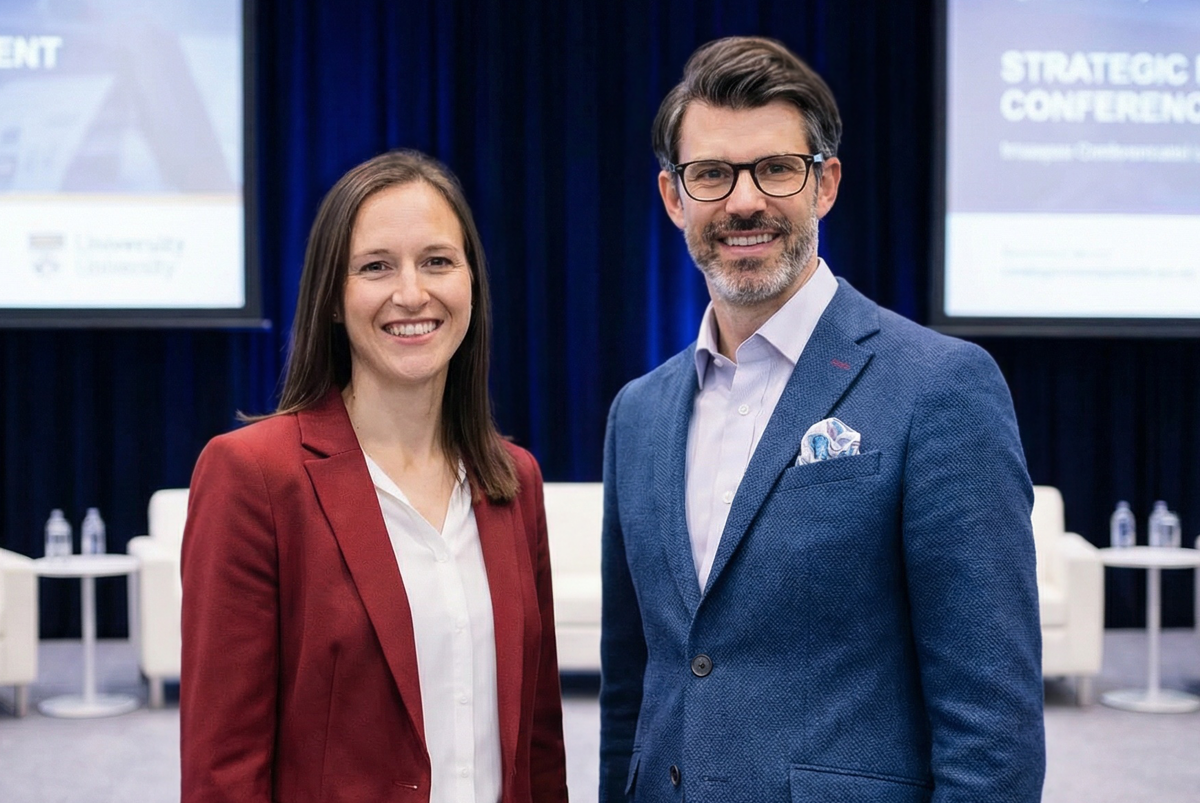

Atlantic Futures is delighted to highlight the publication of a brand new academic article examining how small and medium sized enterprises move from early stage ventures to sustainably scaling businesses.
The article, Locked In or Open Door? Entrepreneurial Scaling Pathways for Local and Global Scaling, has been published in the International Small Business Journal. It has been authored by University of Galway’s Professor Esther Tippmann - alongside Professor Simon Raby from Bissett School of Business, Mount Royal University.
The article introduces the Entrepreneurial Scaling Pathways (ESP) framework - a new perspective on how firms evolve as they seek to scale beyond their initial markets.
Understanding the pathways to scale
While many SMEs aspire to scale, the routes they follow can vary considerably. The ESP framework highlights two key factors that influence how firms develop their growth strategies.
The first factor is business model replicability. This refers to how easily a company can reproduce its business model across new locations or markets. Some firms operate models that are closely tied to a particular place or context, which can limit their ability to expand beyond their home base. Others develop models that can be replicated more easily, creating greater opportunities to scale across regions or countries.
The second factor is intended geographic reach. Firms differ in their ambitions, with some focused on regional or national markets and others aiming for international or global expansion.
The alignment between these ambitions and the capabilities embedded within the business model can play a crucial role in determining whether scaling is achievable.
By bringing these two dimensions together, the ESP framework provides a structured way to think about how different scaling pathways emerge and how firms may move between them over time.
Moving beyond simple notions of growth
The research also challenges the idea that scaling simply means growing quickly. Instead, scaling is presented as a more complex organisational process that requires alignment between what a business aims to achieve and what its business model can realistically support.
Professor Tippmann (Atlantic Futures, Research Stream 2) explains that understanding this relationship is essential for both researchers and practitioners.
“Scaling is often described as growth at speed, but in practice it is a much more complex organisational journey. Firms need alignment between their ambitions and the capabilities embedded in their business model. The Entrepreneurial Scaling Pathways framework helps make sense of how these elements interact and why firms follow different routes as they attempt to scale.”
For founders and business leaders, this perspective provides a useful way of assessing whether their current business model supports their growth ambitions. For policymakers and organisations supporting entrepreneurship, the framework highlights that different firms may require different types of support depending on their scaling pathway.
Relevance for regional entrepreneurship
Understanding business scaling is particularly important for regions seeking to strengthen innovation and entrepreneurial ecosystems.
Across the Atlantic corridor, SMEs play a vital role in driving employment, innovation and regional economic development. Research that improves understanding of how firms grow and scale can help inform policies and initiatives designed to support ambitious businesses and encourage sustainable growth.
Esther's co-author Professor Simon Raby, continued:
“A key takeaway from our work is that scaling rarely follows a straight line. Firms often move back and forth as they experiment with markets, refine their business models and build capabilities. Understanding these pathways helps explain why some companies successfully scale internationally while others struggle to move beyond their home market.”
Supporting the Atlantic Futures research agenda
Atlantic Futures is a collaborative research project involving Atlantic Technological University, Ulster University, University of Galway and the University of Limerick. The project explores entrepreneurship, innovation and regional development across the Atlantic corridor.
Insights into how SMEs scale and expand are central to understanding how regions can foster resilient entrepreneurial ecosystems and support sustainable economic growth.
This publication by Professor Esther Tippmann and Professor Simon Raby provides an important conceptual contribution to this area of research and offers a foundation for future empirical work examining entrepreneurial scaling in practice. Well done to them both for this excellent and important piece of work.
Their article can be accessed in full here:
https://journals.sagepub.com/doi/full/10.1177/02662426261417341
Atlantic Futures is funded through the Higher Education Authority's North–South Research Programme, which supports collaborative research addressing shared challenges and opportunities across the island of Ireland.