
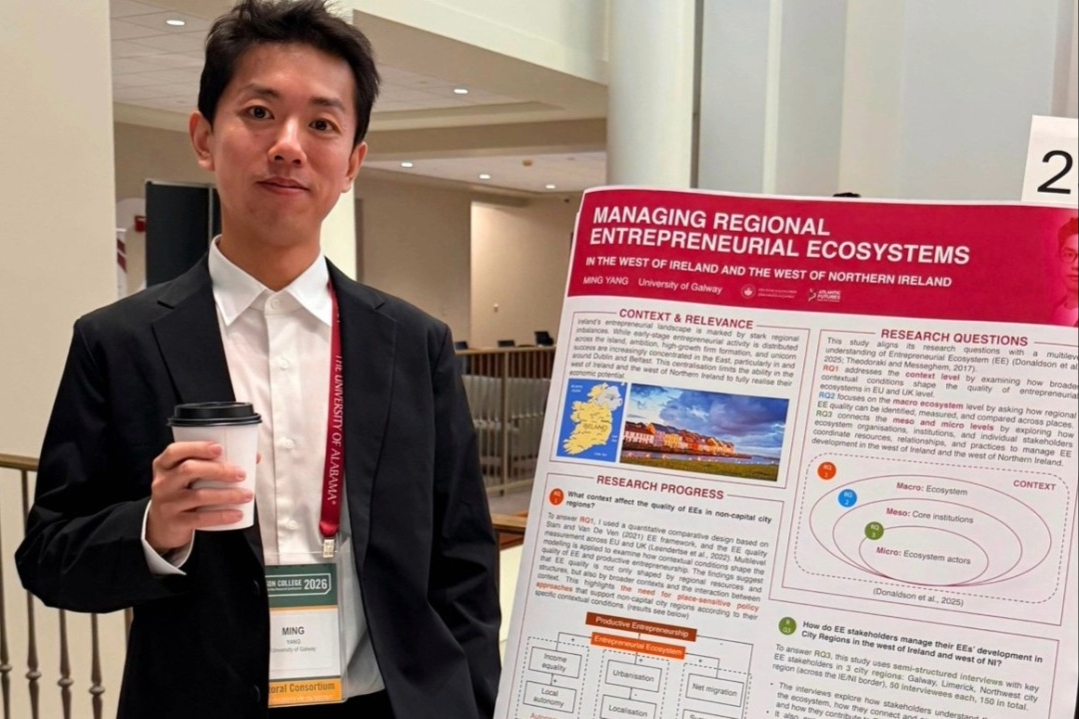

Ming Yang, a PhD researcher at the University of Galway and member of Atlantic Futures Research Stream 1, recently attended the 2026 Babson College Entrepreneurship Research Conference (BCERC) at the University of Alabama in Tuscaloosa.
Ming’s research explores the governance and management of entrepreneurial ecosystems in the Atlantic Innovation Corridor. Guided by Professor Jonathan Levie, he is examining how entrepreneurial ecosystems in rural regions, small cities and towns can be better understood and supported to contribute to more balanced regional development across the West of Ireland and the West of Northern Ireland.
The Babson College Entrepreneurship Research Conference is widely recognised as a leading international gathering for entrepreneurship scholars, providing a space to share emerging research, receive feedback and build connections across the field. For Ming, the conference offered an important opportunity to present his work, engage with new ideas and reflect on how research can support entrepreneurial communities in regional and peripheral places.
His participation contributes to Atlantic Futures Research Stream 1, which compares entrepreneurial ecosystems in rural regions with small cities and towns. The stream seeks to identify the factors that enable local entrepreneurial ecosystems to develop and thrive, helping to address regional imbalances and unlock opportunity across the Atlantic Innovation Corridor.
These are Ming’s reflections.
I recently returned from The University of Alabama, which hosted the 2026 Babson College Entrepreneurship Research Conference. Spending a week engaging with leading scholars in entrepreneurship was one of the most rewarding experiences of my PhD journey so far.
One of my main takeaways from the conference was the importance of adopting a more bottom-up approach to entrepreneurial ecosystem management. Scholars repeatedly highlighted the need for entrepreneurs to participate more actively in ecosystem development, build meaningful relationships, and strengthen community engagement. Rather than relying on one-size-fits-all policies, ecosystem initiatives should respond to the specific needs and capabilities of local communities. This is particularly important in rural and peripheral regions.
I also received valuable feedback on my own research. I was honored that my poster was selected as a finalist for the Best Poster Award, reflecting the interest shown by the reviewers and judges in the conference. At the same time, their comments encouraged me to think more critically about the limitations of the research and how its findings might be extended beyond the Irish context to other regional settings.
Overall, the conference was an invaluable experience. I benefited greatly from the sessions and lectures delivered through the Doctoral Consortium and had the opportunity to connect with scholars who may become future collaborators. I look forward to applying the insights, ideas, and feedback I gained to the next stage of my research.